

-
Navy Products
navy-products
-
Ocean Camel™ — Composite Floating Camel

- Construction: Composite floating camels constructed from reinforced plastic timbers, ultra-high-strength steel pipe, or seal-welded tubular steel, depending on application — providing a positive-buoyancy standoff between vessels and piers.
- Foam core: All sealed chambers 100% filled with closed-cell urethane flotation foam — not internal water ballast — ensuring the camel stays afloat and functional even under sustained load.
- Skin/wear surface: Thick, tough, abrasion-resistant non-marking urethane wear surface protects vessel hulls while distributing berthing loads across multiple pier pilings.
- End fittings: Available with dual hawse pipes or integral swivel end fittings, depending on camel design and application.
- Deck & features: Non-slip decking, optional deck fittings, custom colors, and additional buoyancy modules available across all designs.
- Compliance: Constructed to current US Navy specifications for commercial and military berthing applications.
Camel Variants:
- LC — Camel Logs: Composite cylindrical floating camels available in two core types — ultra-high-strength steel pipe (urethane foam-filled, with dual hawse pipes or swivel end fittings) or plastic pipe (urethane foam-filled, dual hawse pipes).
- CPC — Composite Plastic Camels: Barge-type floating camels built from reinforced plastic timbers with closed-cell buoyancy modules, offered in numerous designs and configurations.
- SSC — Surface Ship Camel: Sealed tubular steel design berthing CH and DDG class surface vessels, with 100% closed-cell foam fill, non-marking grey fenders, anti-fouling coating, 316 stainless steel hardware, and a 10 ft × 40 ft composite decking working platform.
- DDC — Deep Draft Camel: Available in two configurations — the DDC-FA (lightweight, seal-welded tubular steel, open-bottom pipes, vertically positioned submarine side fenders, narrow berthing footprint) for fast-attack submarines, and the DDC-AC (wide-body design with a large composite working platform) for all submarine classes.
-
Ship Separator — DDG Class Ship Separator
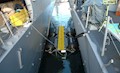
- Structure: Square tubing construction (in lieu of angle iron) designed to nest U.S. Navy Arleigh Burke-class guided missile destroyers and provide standoff during ship-to-ship mooring or breasting operations.
- Foam core: Incorporates four 6 ft × 12 ft foam-filled fenders, with all sealed members 100% filled with closed-cell polyurethane foam for energy absorption and flotation.
- Fender backing: Double-wall fender backing plates add structural durability and extend service life under repeated berthing loads.
- Hardware: All attachment hardware is 316 stainless steel for corrosion resistance in harsh marine environments.
- Deck & features: Removable handrails, composite decking, and towing/mooring cleats available, with a variety of coating systems offered.
- Applications: Also used for ship-to-wharf mooring, providing standoff between a vessel and the dock in addition to ship-to-ship nesting.
- Compliance: Constructed to current US Navy specifications for Arleigh Burke-class (DDG) destroyer nesting and breasting operations.
-
Ocean Guard™ SSD — Small Standard Duty foam-filled fender
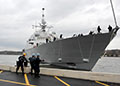
- Skin: Thick, tough filament nylon tire cord reinforced polyurethane skin, applied in a helix pattern for unsurpassed strength and durability against weather, forces, and marine conditions.
- Foam core: Heat laminated, 100% closed-cell foam core — high energy absorbing, low reaction force, and cannot be ruptured.
- Fabrication: No adhesives used in construction, which eliminates the breakdown issues adhesives cause over time — adding to long-term durability.
- End fittings: Integral end fittings in stainless steel or galvanized steel (SSD-HP variant adds an integral hawse pipe).
- Compliance: Constructed to current US Navy and US Coast Guard specifications.
-
Ocean Guard™ Mooring Buoy — Foam-Filled Mooring Buoy
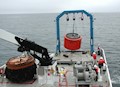
- Skin: Thick, tough filament nylon reinforced polyurethane elastomer skin, non-marking and abrasion-resistant, built to withstand weather, forces, and marine conditions.
- Foam core: Heat laminated, closed-cell impact-absorbing foam surrounding a closed-cell rigid urethane flotation foam — unsinkable and puncture resistant even if the outer skin is compromised.
- Central strength member: Central steel strength member provides high pull-through strength for the safe mooring of large vessels.
- End fittings: Available in Mooring Tee, Quick Release Hook, or Hawser Pipe design, with a variety of end fittings to match mooring requirements.
- Features: Non-skid deck, internal radar reflectors, corrosion-resistant and low-maintenance construction — lighter than conventional steel buoys and easy to handle.
- Compliance: Constructed to current US Navy and US Coast Guard specifications.
-
Ocean Guard™ Pneumatic Fender
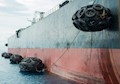
- Construction: Layers of high-strength tire-cord material encased in a thick rubber skin, providing structural stability while resisting abrasion and environmental wear.
- Function: Internal pressure system compresses air during vessel contact, absorbing kinetic energy and reducing the force transmitted to both vessel and dock — offering higher energy absorption than foam-filled fenders of the same size, particularly effective in areas with high tidal variation.
- Fittings: End flanges with inflation and deflation valves, safety pressure relief valves, and optional chain and tire nets or rope nets depending on the application.
- Sizing: Available in a range of diameters and lengths to meet port and vessel requirements, with customized options available upon request.
- Deployment: Buoyant, corrosion-resistant, and easy to install — can be deflated for transport or storage and re-inflated on-site, suitable for permanent installations as well as temporary deployments during ship repair or fleet reconfiguration.
- Accessories: Complete range of support equipment available, including mooring chains, shackles, towing rings, quick-release hooks, and inflation kits.
- Compliance: Tested according to US Navy, Coast Guard, and ISO 17357-1:2014 guidelines, with third-party testing and certification available based on project specifications
-
Ocean Barrier™ — Port Security Barrier System
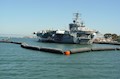
- Foam core: Heat laminated, 100% closed-cell foam core — high energy absorbing, low reaction force, and cannot be ruptured.
- Fabrication: No adhesives used in construction, which eliminates the breakdown issues adhesives cause over time — adding to long-term durability.
- Skin: Thick, tough filament nylon reinforced polyurethane skin, providing unsurpassed strength against weather, forces, and marine conditions.
- Customization: Custom-built to the customer's needs in size, shape, color, and design.
- System integration: Can be paired with other MFI products — such as Ocean Guard™ buoys and Ocean Guard™ donut fenders — to create a total integrated floating barrier system.
- Applications: Designed for use at military facilities, ports, harbors, ships, and private facilities, providing a highly visible physical deterrent for maximum security and safety.
- Performance: Rugged yet burst-resistant, easy to install, and extremely effective as a security barrier.
-
Ocean Guard™ Hydropneumatic Fender
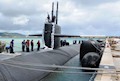
- Construction: Layers of high-strength tire-cord material encased in a thick rubber skin, providing structural stability while resisting abrasion and environmental wear.
- Fittings: End flanges with inflation and deflation valves, safety pressure relief valves, and optional chain and tire nets or rope nets depending on the application.
- Function: Internal pressure system compresses air on vessel contact, absorbing kinetic energy and reducing force transmitted to both structures — often deployed alongside surface-level pneumatic fenders to maintain protection below the waterline for deep-hulled vessels like submarines.
- Deployment: Buoyant, corrosion-resistant, and easy to install — can be deflated for transport or storage and re-inflated on-site, suitable for both permanent installations and temporary deployments.
- Accessories: Complete range of support equipment available, including mooring chains, shackles, towing rings, quick-release hooks, and inflation kits.
- Compliance: Tested according to US Navy, Coast Guard, and ISO 17357-1:2014 guidelines, with third-party testing and certification available based on project specifications.
-
Ocean Guard™ Fender
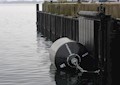
- Skin: Thick, tough filament nylon reinforced non-marking urethane skin, with nylon tire cord applied in a helix pattern for unsurpassed strength and durability against weather, forces, and marine conditions.
- Foam core: Heat laminated, 100% closed-cell foam core — high energy absorbing, low reaction force, and cannot be ruptured.
- Fabrication: No adhesives used in construction, eliminating the breakdown issues adhesives cause over time — adding to long-term durability.
- End fittings: Integral swivel end fittings constructed of top-quality steel, providing a secure attachment point that doesn't obstruct even when compressed.
- Internal chain: Heavy-duty stud link chain internally connects the end fittings, ensuring maximum pull-through strength and even distribution of energy and stresses.
- Compliance: Constructed to US Navy specifications.
